Showing posts with label reduce. Show all posts

Saturday, June 16, 2012

Teen new requirements could reduce driving deaths

Teen new requirements could reduce driving deaths

The Detroit Bureau

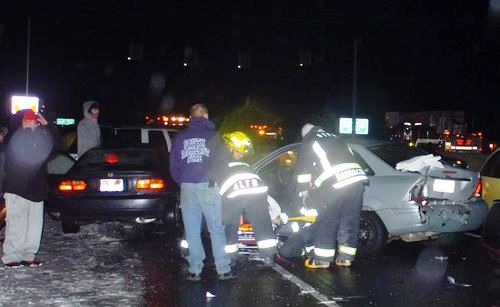
Emergency teams struggle to save young people in a nighttime accident involved.

By Paul A. Eisenstein, the Detroit Bureau
Motor vehicle crashes are the leading cause of death for U.S. teens, according to government statistics, but a new insurance industry report suggests that the numbers could sink, by restrictions on teen drivers tighten laws.

Car crashes for one of three people responsible reported among young people are for highway safety projects that could be saved through the use of more restrictive licenses annually at least 500 lives every year the Centers for disease control, but the new study of insurance. In some Member States, which IIHS said it expected the mortality rate among teen drivers of less than 50% fall.

The new study emphasised it best-practice guidelines adopted, called from various Member States, including driving a ban with Teen passengers, limited night rides and a request for the supervised.

Ford to offer 98,000 pensioners of buyouts

"Even the best States can do better", says Anne McCartt, senior Vice President for research at IIHS. "There is room for improvement in all areas, and States could see claims immediate reduction in fatal crashes and collision, once regulations are in place to strengthen."

States with the toughest constraints the sharpest decline in teen of fatalities compared to those with less restrictive policy signed the IIHS reported. The Institute isolated five specific policies which seem to help:

Later driving age, 17 in New Jersey;They allow later age 16 in district of Columbia, New York, Massachusetts, Delaware, and five other States;At least 65 hours of supervised driving in Pennsylvania;Night driving ban in Idaho, South Carolina; AndA ban teen passengers in 15 States and Washington, D.C.
The IIHS report indicates that all but nine States now have to allow so-called graduated driver's licenses or GDLs, the young people to build up experience and maturity behind the wheel. There are three levels: a period of supervised driving under a learner who allow, meanwhile licensing, certain restrictions, followed by a license that manages full permissions.

Chevrolet inks deal with Manchester United

Since the year 2000, the IIHS has been assessed the various countries according to the effectiveness of their teen driving regulations. Initially only six States and D.C. evaluation "Good". Today however is the up to 36 States and district. Another seven earn now "faire" reviews, with seven other rated "Marginal."

But the IIHS says that the steam run the transition to more stringent restrictions has and it move to state legislators to act a new strategy that moves the public get a sense of how many lives could, with stricter rules be saved. Click here , to the computer on the IIHS Web site access.

"States have to not the toughest laws in the nation Security realize profits." Strengthening pays off one or two components. To maximize all the benefits of tiered licensing but we encouraged legislators to consider, "McCartt says the strongest provisions."

Lenders loosen car loans

South Dakota, could for example see a full 63% drop in fatal crashes, the IIHS projects and a decline in the collision claims by 37%.

Even States which have adopted many of the proposed restrictions, could be better, says McCartt. By the further increase of his age minimum license, increasing driving hours monitored and drive a night add constraint, the insurance would trade group projects Connecticut of a 17% drop in fatal crashes and 13% reduction in claims see collision.

McCartt recognizes that while further restrictions it supports may be difficult is the evidence that legislators Act taking into account the proposals are always "politically popular."

Friday, May 6, 2011

Other models reduce the production of the new civic, Honda

DETROIT - Honda Motor Co., warned that Monday, the it popular U.S. dealer behind the models such as the civic bottlenecks are compact this summer because of the parts of Japan's earthquake damage.

It said that normal production may not return until the end of the year.

Honda is cut significantly production of the new civic 2012, the sixth most popular car in the United States, by the summer, if not longer.

In addition version of CR-V of small SUV will be delayed the 2012 by at least one month this fall. Make up to shortages, Honda will make the 2011 version.

Both vehicles are in North America, but like other automakers, Honda must cut production because it is running out on Japanese imports of chips, sensors and other parts. Japanese plants that produce them have been on 11 March earthquake damaged or hindered by power outages.

Almost all the major car companies had idle factories bottleneck. Honda, Toyota Motor Corp. and Nissan Motor Co. have hit particularly hard. Supply companies are scrambling to make their parts from elsewhere, but set up alternative factories will take months.

Honda, which makes sold 80 percent of the vehicles in North America plants in the region, also said that it can import only a limited number of Japan of of cars built in the United States which means that traders do not fit subcompact, and the CR-Z, Insight and civic gas-electric hybrids can order until later in the year.

"Our goal is to normalize production at some point to the end of the year," wrote John Mendel executive Vice President of sales for American Honda, traders, memo.

Bottlenecks are also cut supply with some Acuras, Honda's luxury cars. Traders are not the TSX small car and wagon and the RL order large saloon until later in the year, the memo said.

The deficiency come as gasoline in the United States hit $4 a gallon in 13 States is time. -Drives, the models typically up-saving fuel sales of Honda and Toyota.

Honda spokeswoman Christina RA conceded that the production cuts could send some buyers to other brands, but she said that some buyers wait, could be ready.

"We certainly production beef things can get once back to normal," she said.

Honda sold almost 67,000 civics to March, by 21 percent compared to the previous year. Rose to 58 percent sales of CR-V, which ranks No. 11 in U.S. sales, just over 57,000 by March.

Some industry analysts think production cuts by Japanese automakers could help, General Motors, Ford, Chrysler, Hyundai and other car manufacturers affected by parts shortages not so hard.

GM, Ford and Hyundai have far better entries in the compact car market than in the past, and buyers who have purchased a Honda or Toyota automatically would be, may end try other brands.

Mendel's memo said Honda jobs would have to use some color pigment in Japan were produced due to missing certain shiny. RA said the colors are types of red, blue, dark grey and white.

Last month Honda said production in its 10 US and Canadian car factories would significantly slow down in at least early may bottleneck. The company still says, none of its 21,000 North American factory workers will be dismissed. Toyota has made similar movements in North America.

Separately, a Toyota remains motor factory in Huntsville, Ala., for lack of electricity. Alabama was devastated by tornadoes Wednesday and spokesman Mike Goss said Toyota is not sure if the plant is open again.

The plant makes engines for the tundra and Tacoma pickup trucks and the Sequoia SUV.

Goss said factories, which assemble the vehicles are so far unaffected. The pickups are IND in San Antonio, Texas, while the Sequoia Princeton, is formed.

Copyright 2011, the associated press. All rights reserved. This material may not be published, broadcast, rewritten or distributed.