Showing posts with label investors. Show all posts

Sunday, August 11, 2013

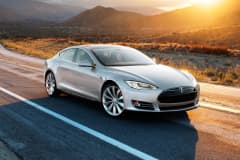
Investors close result back to Tesla surprise

Investors close result back to Tesla surprise
Brave connector automotive manufacturer engine delivered Tesla or how it go out a modest profit, rather than the loss analysts forecast a surprise with its results in the second quarter announcements had.

After a sharp sell-off in the course of the day, which quickly topple Tesla shares to 5.5 percent before the closing bell on Wall Street investors saw of course vice versa, get almost immediately shop a 14 percent in trading after hours.

The strong could cut egg left, on the faces of the skeptical analysts, of which some strongly negative reports for the first time had issued after Tesla's in January to March quarter profit.

For the last quarter, net income jumped 70 percent on a non-GAAP basis, $26 million. This leads to the earnings per share by 20 cents, excluding one-time charges. The consensus forecast was for a loss of 19 cents.

Despite the better than expected profit warning Tesla CEO Elon Musk, that has a number of challenges to focus the Californian start up and the result not at the top of the list. In other words, increase the production of the manufacturer's model s of course contributed to that is the bottom line, overcoming a significant reduction of ultra low emission vehicle credits, which the companies in the Red punch was expected.

Tesla was impressive 25 percent boost in the second quarter production in the past three months to 500 vehicles per week. The company's original forecast was for 4,500 deliveries, but it seems to have reached 5,150.

That helped its gross margin (again on a non-GAAP basis) to 22 per cent, the manufacturer with a fourth quarter target of 25 percent boost. Sales reached $551 million, almost 40 percent in the second quarter more than the consensus forecast of $395 million.

In the meantime of the manufacturers entered in the third quarter with nearly 750 million $ in cash and - perhaps more important – without a penny in government securities. It received a huge popular response to his recent has offer a federal loan to pay off gear helped high-tech vehicle development. The money helps Tesla fund development (expected to end next year on the market), model X-crossover, as well as a lower-cost, more mainstream model now, musk has been promising.

An Internet pioneer, as a CEO who has rocket company SpaceX and Chairman who serves SolarCity, musk repeatedly defied conventional wisdom - and the fact that only a few other manufacturers pulling power in the nascent battery car market to have won.

He ordered a series of measures for the improvement of the long download time on appeal of a technology that hobbled by high costs, limited range, and the uncertainty about the battery life.

These steps include what musk described as a "bullet-proof guarantee program" when was earlier this year announced. Tesla is also in the middle of a nationwide network of high-speed "Compressor" stations set up and demonstrated plans to allow fast battery swap.

The company dropped the price of the least expensive version of the Tesla model S this year, as the vast majority of buyers selected expensive, but group tourism versions - which has helped also, margins and earnings buoy.

Tesla suggest results - and some, musk of contagious enthusiasm - have clearly worked with investors.The stock was as high as $145,73 in recent days, up from a 52-week low of $26,86 being executed. Although it early in the week as media reports indicated that the manufacturer for the second quarter in the loss zone for would fall sputtered, investors have generally shrugged off negative forecasts.

These included a report by Goldman Sachs last month, a top end value closer set to $83 per share. Meanwhile, Donn VICKREY warned of gradient Analytics, that Tesla earned an "F", warns result, that "the company's results were driven by repeated increases and accounting gimmicks that are either unsustainable or purely cosmetic."

Given the lingering uncertainty about the battery-car market and the growth that Tesla will probably continue to support giving more cheerful note investors must, it is still far from certain if the manufacturer builds momentum can be continued.

Monday, October 17, 2011

Ford’s union deal could help investors too

Signing bonuses, profit sharing checks and inflation protection aside, Ford is billing its tentative new contract with the United Auto Workers union as a significant step forward in its bid for competitiveness — and CEO Alan Mulally’s goal of rebuilding the carmaker’s credit rating.


In fact, Ford shareholders could benefit from the deal as much as Ford’s unionized workers, especially if the new settlement helps the automaker restore its once-lucrative dividend payments.


“We believe this agreement ... will enable us to increase our overall competitiveness in the United States,” said Ford’s labor and manufacturing chief John Fleming, something he underscored by noting that the four-year contract, if ratified, will “also permit us to in-source work from Mexico, China, Japan and other parts of the world.”

Wild Wall St. Has the market volatility got you nervous? These cartoons may give you a little comic relief.

Cyber-thieves create fake Kelley Blue Book site US says Reebok toning shoes don't really Can you live on $9 an hour? Play the game

The settlement at Ford, reached Tuesday morning, comes nearly three weeks after the UAW union came to terms with General Motors, and the proposed contract largely follows the GM pattern.


That means an improved profit-sharing program, a signing bonus and inflation protection. But Ford, considered the healthiest of the Detroit carmakers, bumps the up-front cash to $6,000, a full $1,000 more than at GM, while it will offer four $1,500 lump sum payments meant to compensate for inflation, double what its crosstown rival came up with. Significantly, Ford and GM both avoided any fixed increases in wages — a move that auto analyst Joe Phillippi sees as critical to the companies' long-term competitiveness.

Ford, UAW reach tentative contract pact

He isn’t alone. Standard & Poor’s has signaled that it might follow an upgrade in GM’s credit rating by also upgrading Ford’s rating. That would meet one of Mulally's top goals — something Ford highlights on its website.


An investment grade rating would deliver more than just bragging rights. It would also mean a significant savings on Ford’s hefty debt. The carmaker borrowed heavily going into the last recession to ensure it could survive. As a result Ford — unlike GM and Chrysler — was able to avoid bankruptcy and a bailout from the federal government.


An upgrade “is paramount in Alan’s mind,” said Phillippi, founder of AutoTrends Consulting. “It would not only help lower [Ford’s] debt costs, but also signal their willingness to reinstate the dividend. They could do that now, but the ratings agencies would probably respond better if they wait until the debt rating has been restored.”


While Ford — like the rest of the auto industry — has been slammed by Wall Street in recent months it is generally seen as best positioned to take advantage of an eventual economic recovery. Ford’s sales were up 9 percent in September, well ahead of some key import competitors, including Honda and Toyota.


Ford remains a leader in the pickup market, with its F-Series and other light truck segments. But with models like the new Fiesta subcompact and midsize Fusion the automaker also is  gaining traction in the passenger car segment where it was long an also-ran.


As a result of the new contract, Ford will expand production of the Fusion, now built in Mexico, by adding a line at its plant in Flat Rock, Mich. That factory, known as AutoAlliance, has been operating as a joint venture with longtime affiliate Mazda Motors. But Mazda plans to pull out of the plant, and there had been concerns the facility would close. Its future seems to be rosy as a result of the new UAW contract.


Indeed, Ford’s Fleming announced that the carmaker will add another 5,750 U.S. hourly jobs once the contract is ratified, bringing to 12,000 the number of jobs it has either added or saved. All the new jobs, however, will be classified Tier II, meaning those employees will make significantly less than veteran Ford line workers. To soften concern among the rank-and-file, Ford has agreed to boost Tier II wages by $3.78 an hour to $19.28, still significantly less than the top tier makes.


Ford also will offer buyouts to veteran workers to open up even more Tier II jobs and lower labor costs further.


The auto industry has traditionally had a strong impact on what happens in the rest of American manufacturing, and the settlements at GM and now Ford are being well received, with Jay Timmons, president of the National Association of Manufacturers, declaring that this week’s [Ford] announcement “will create jobs, will make the manufacturing sector stronger.”


For the UAW, it’s two down and one to go. The union still needs to work up a settlement with Chrysler, the smallest and weakest of Detroit’s makers. A settlement seemed close at hand as negotiations approached the Sept. 14 expiration of the old four-year contract. But an unexplained glitch led UAW President Bob King to walk away from Chrysler and focus on the GM settlement -- a move that triggered the rage of Chrysler’s CEO Sergio Marchionne.


The two have since tried to patch things up and negotiations are again moving ahead, though Chrysler is reportedly balking at the signing bonuses and Tier II wage hikes approved at GM and Ford. It insists that anything that increases its costs — which average $50 an hour — must be offset by cuts in other areas.


Observers expect both sides will bend. If not, they face unforeseen risks. Terms of Chrysler’s 2009 federal bailout prohibit both a strike and a company lockout. As a result, a deadlock would leave the final terms of a settlement up to binding arbitration.


© 2011 msnbc.com.  Reprints