Showing posts with label Google. Show all posts

Thursday, August 29, 2013

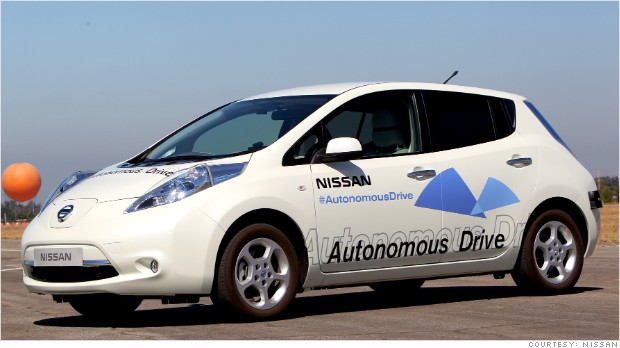
Nissan plans to begin selling self-driving cars by 2020

Nissan plans to begin selling self-driving cars by 2020

IRVINE, Calif., Aug 27 Reuters)-Nissan Motor Co. Ltd. said it ready by 2020 fully self driving vehicles on the market will bring.

The Japanese automaker said "Multiple, commercially viable" are planned offer vehicles that are autonomous operation without driver.

Self-driving vehicles "at realistic prices for consumers" are sold the company in a media event in Irvine, California.

Nissan said the aim is the autonomous vehicles "through the lineup within two generations of vehicles" - about 10-12 years after the planned 2020 launch offer.

The company said research and development of autonomous vehicles "for years" was with such top universities such as Oxford, Stanford, Carnegie Mellon, Massachusetts Institute of technology and the University of Tokyo. It builds a dedicated test track in Japan for autonomous vehicles, which will be completed by next spring.

Google Inc., the leader in Internet search, an autonomous car program launched in 2010 in life and has developed and is testing different versions, including one on the basis of Toyota Motor Corp Prius.

Tuesday, May 29, 2012

Fiat uses Google Street to photo bomb VW

The Detroit Bureau


That's a Fiat 500, not the VW Up! in front of the German maker's Swedish HQ.

By Paul A. Eisenstein, The Detroit BureauAutomakers normally take their marketing efforts quite seriously, not surprising when you consider the billions of dollars at stake. But every so often, a little humor creeps in – such as the Tweets Ford has been sending out about General Motors’ decision to stop advertising on Facebook.

Fiat, it seems, took a more creative approach to “punking” its rival Volkswagen AG.

Fisker Delaying Atlantic Plug-in Launch By Full Year

Search for the German maker’s Swedish headquarters using Google Street View and parked right in front of the main door and you’ll find a little Fiat 500.

Exactly how the stunt was pulled off isn’t clear. The two makers have their offices fairly close to one another but the challenge is knowing when the Google camera car rolls by. Apparently, once the Fiat folks figured that out they quickly got into position and posed.

E15 Fuel Could Wreck Engines, Study Warns

The folks at Tecca.com first spotted the gag and noticed that the red Fiat 500 tagged along for a while, positioning itself in several other street scenes.

For those not familiar with the service, Google Street View provides a panoramic look at urban, suburban and even many rural roads around the world. The images are recorded from a fleet of specially-equipped vehicles. Where roads are inaccessible the company will even use Google Trikes and snowmobiles. And portable units have been added to offer panoramic views of places such as the White House.

The Detroit Bureau

The Fiat 500 pulls out and gets ready to pose for several other Google Street View images.

Spend enough time searching through the extensive database and you’ll find a number of other pranks from those who spotted the Google camera car in time to offer a “moon” or some other suggestive pose.

Those Underinflated Tires Could Kill You

In fact, Google itself got into the game earlier this year, briefly switching from the normally hi-res images to an 8-bit version for April Fools Day that had the resolution of an early Atari videogame.

Friday, April 13, 2012

Blind driver takes Google car for a spin


A video released by Google shows Steve Mahan, who is 95 percent blind, behind the wheel of its experimental self-driving car.

By Dan Carney, msnbc.com contributor

A blind guy driving a car? That was the latest step in Google's two-year-old program to develop a self-driving car.


A video released last week on YouTube shows Steve Mahan, who is almost totally blind, behind the wheel of a Toyota Prius, running errands to Taco Bell and the dry cleaners.


"Look Ma, no hands, and no feet!" Mahan says as the car steers autonomously along a carefully planned route. "This is some of the best driving I've ever done."


Google announced its self-driving car project in 2010, building on research started by a Stanford University that won a $2 million Defense Advanced Research Projects Agency challenge.


Although the Google demonstration followed a preplanned route, it shows the potential for such cars to work without extensive preparation, said spokesman Jay Nancarrow. But he said the company was not prepared to detail the vehicle's capabilities and limitations.


Autonomous cars outfitted with radar and laser sensors like the Prius would be liberating to people such as Mahan, who cannot drive on his own. “Where this would change my life would be to give me the independence and the flexibility to go to the places I both want to go and need to go, when I need to do those things,” Mahan said after his day in the car, which took place in January.


Even those without vision loss could benefit from the automation of driving because  computer-controlled cars would be able to drive in close formation to increase the traffic capacity of existing roads, said Google project leader Sebastian Thrun. This would save Americans 4 billion hours of wasted time and 2.4 billion gallons of gasoline, he estimated.


Thrun spoke at the TED conference last year about his personal motivation to develop a self-driving car. “As a boy I loved cars,” he said.  “When I turned 18 I lost my best friend to a car accident. Then I decided I would dedicate my life to saving 1 million people every year."


Tangi Quemener / AFP/Getty Images


Junior, a 2006 Volkswagen Passat, heavily modified and robotized by a team of Stanford University, crosses the finish line in first place of the DARPA Grand Challenge on Nov. 3, 2007, in Victorville, Calif.


His effort started with Stanley, a Volkwagen station wagon outfitted with sensors, which in 2005 was the first vehicle to complete DARPA’s challenge course.


“Since then our work has focused on building cars that can drive anywhere by themselves,” he said.


“Our cars have sensors with which they magically can see everything around them and make decisions about every aspect of driving. It is the perfect driving mechanism. We’ve driven in cities, like in San Francisco here. We’ve driven from San Francisco to Los Angeles on Highway 1.  And even crooked Lombard Street in San Francisco.”


Another video shows the Google autonomous Prius ripping through a snaking course of orange cones in a parking lot. This capability suggests the autonomous car need not proceed at the pace of a driver's ed student. 


Finally drivers would be able to focus on things they’ve already shown are more important to them than watching the road, like talking on the phone, texting friends, checking Facebook, eating and personal grooming. Maybe they could watch the YouTube video of the blind guy in the driver's seat.